
Table of Contents
ToggleUnion Budget 2026 and the Rise of the ‘Orange Economy’: A New Era for AVGC Skills in India
India’s Union Budget 2026 has sent a strong and clear message—creativity is no longer a side sector; it is a core economic driver. By giving major recognition to the ‘Orange Economy’, the government has placed animation, visual effects, gaming, and comics (AVGC) at the center of India’s future growth story. This move reflects how culture, creativity, and technology are coming together to create jobs, innovation, and global opportunities for young Indians.
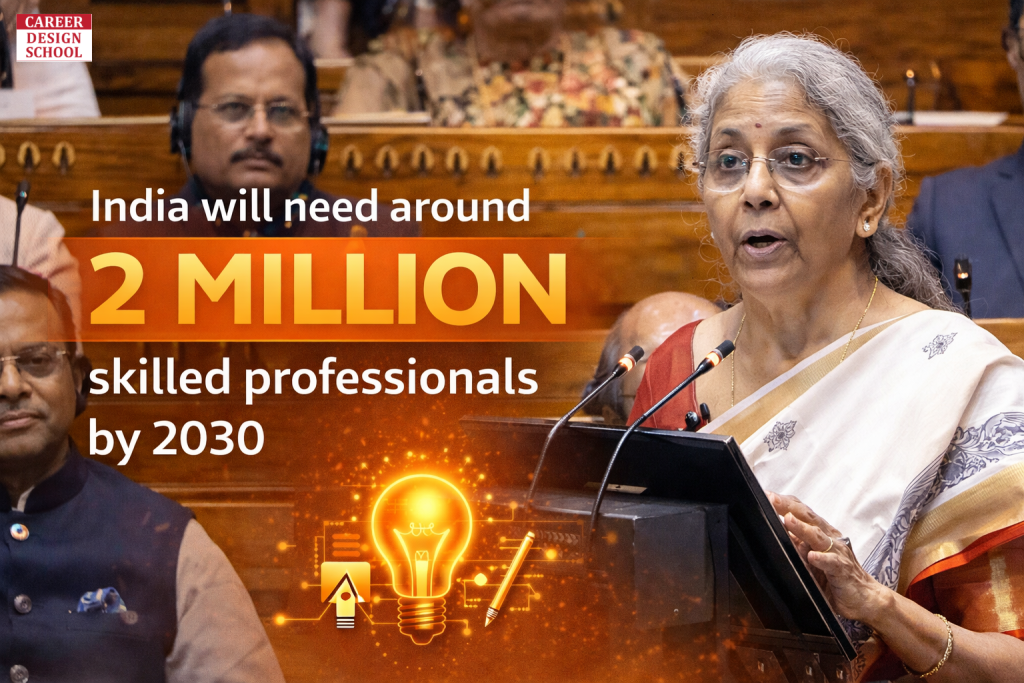
In her Budget 2026 address, Nirmala Sitharaman highlighted AVGC as one of the fastest-growing sectors, with projections showing that India will need around 2 million skilled professionals by 2030. This recognition marks a turning point for students, educators, and creative institutions across the country.
What is the ‘Orange Economy,’ and why does it matter?
The ‘Orange Economy’ refers to industries driven by creativity, design, content, and intellectual property. In India, this includes animation, VFX, gaming, comics, digital design, storytelling, and interactive media—together known as the AVGC sector.
Globally, AVGC is already a multi-billion-dollar industry. India, with its young population and growing digital ecosystem, is perfectly positioned to become a global hub. However, the biggest challenge has been skilled talent at scale. Budget 2026 directly addresses this gap.
Budget 2026: Big Push for ‘Orange Economy’ AVGC Talent Development
One of the most important announcements under India’s Budget 2026 is support for the Indian Institute of Creative Technologies (IICT), Mumbai, which will lead the creation of AVGC Content Creator Labs across the country.
These labs will be embedded directly into the education system:
- 15,000 secondary schools
- 500 colleges
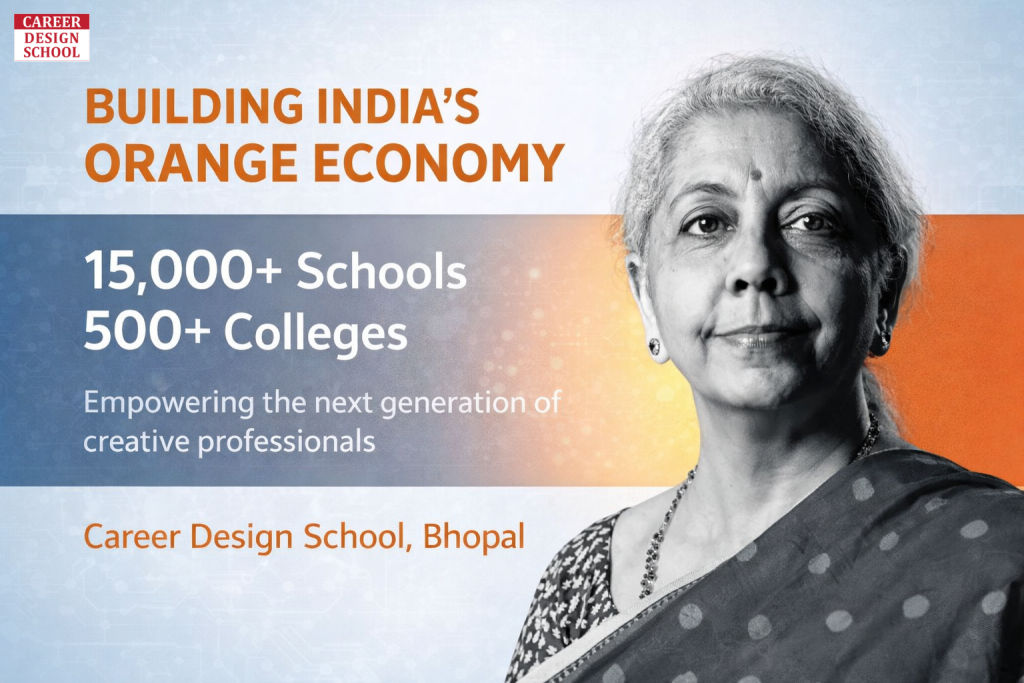
This means students will get early exposure to animation, gaming, design, and digital storytelling—much before they enter the job market. The goal is simple: build a strong, continuous learning pipeline and ensure India has a steady supply of creative-tech professionals.
Alongside AVGC, the Budget also recognises that the Indian design industry is growing rapidly, but there is a shortage of trained designers. To address this, the government has proposed setting up a new national institute of design through a challenge-based route, further strengthening India’s creative education ecosystem.
Watch now: Big Opportunity for Creators!
Why is AVGC a career opportunity like never before?
The AVGC sector is no longer limited to movies or cartoons. Today, it spans:
- Games and e-sports
- OTT content and web series
- Advertising and brand design
- AR/VR and immersive experiences
- UI/UX and digital product design
With global studios outsourcing work to India and Indian creators building original IPs, the demand for skilled professionals is exploding. Budget 2026 makes it clear that AVGC is a long-term, high-growth employment sector, not a temporary trend.
How Career Design School (CDS) aligns with the government’s vision!
While policy sets direction, institutions on the ground turn vision into reality. In Central India, Career Design School (CDS), Bhopal, is an example of an institute that is already aligned with the government’s focus on the Orange Economy and AVGC skills.
Located in Bhopal, CDS makes quality design and AVGC education accessible to students from Madhya Pradesh, Chhattisgarh, and nearby states—without forcing them to move to metro cities like Delhi or Mumbai. This directly supports the Budget’s idea of widening access to creative-tech education.
CDS was founded under the leadership of Manish Rajoria, a pioneer in animation and IP creation, and is affiliated with Raja Mansingh Tomar University, Gwalior. The school blends creative freedom with technical depth, exactly what the AVGC industry demands.
Learning that matches industry needs
One reason the AVGC sector struggles with talent shortages is the gap between education and industry. CDS addresses this by keeping its curriculum 70% practical, with:
- Live industry projects
- Portfolio building from semester one
- Exposure to real production pipelines
Students work in environments similar to professional studios, using tools and workflows expected by the industry. The presence of animation studios, game labs, UX workspaces, motion capture, and green screen facilities ensures that learning is hands-on, not theoretical.
CDS also supports the creative ecosystem through an incubation centre for design in Central India, encouraging original ideas, startups, and IP creation—another key goal of the Orange Economy.
Programmes supporting the AVGC future
In line with the AVGC and design focus highlighted in Budget 2026, CDS offers:
- BFA Animation (4 Years) – 2D/3D animation, VFX, storytelling
- B.Des Game Design (4 Years) – game art, level design, Unity/Unreal
- BFA Painting (4 Years) – fine arts and digital art
- Diploma & Certificate Programmes – Graphic Design, UX/UI, VFX, Motion Graphics (NSDC-aligned)
These programs are designed to create job-ready professionals who can directly contribute to the Orange Economy.
Conclusion: Budget 2026 and the creative future of India
India’s Budget 2026 has firmly established the ‘Orange Economy’ and AVGC sector as pillars of future growth. With projections of 2 million jobs by 2030, early skilling initiatives, and strong policy backing, creative careers are entering the mainstream.
Institutions like Career Design School, Bhopal, show how this vision can be implemented on the ground—by combining affordability, industry focus, and practical learning. As India builds its creative-tech workforce, the alignment between government policy and forward-thinking education will decide how successfully the country leads the global AVGC revolution.
By: Rishabh Pandey